Growing guide
How to Grow Echinacea From Seed (Without the Patchy Germination)
Purple coneflower is a genuinely rewarding perennial that most people get wrong at the very first step. The fix costs nothing and takes four weeks of doing nothing.
By The Homestead Shelf · Updated 25 August 2026 · Echinacea purpurea · Perennial
Difficulty
Hard
Germination
10–30 days, erratic without stratification
Sow depth
3–6 mm, lightly covered
First flowers
Usually flowers in year two
Why your echinacea seeds did not come up
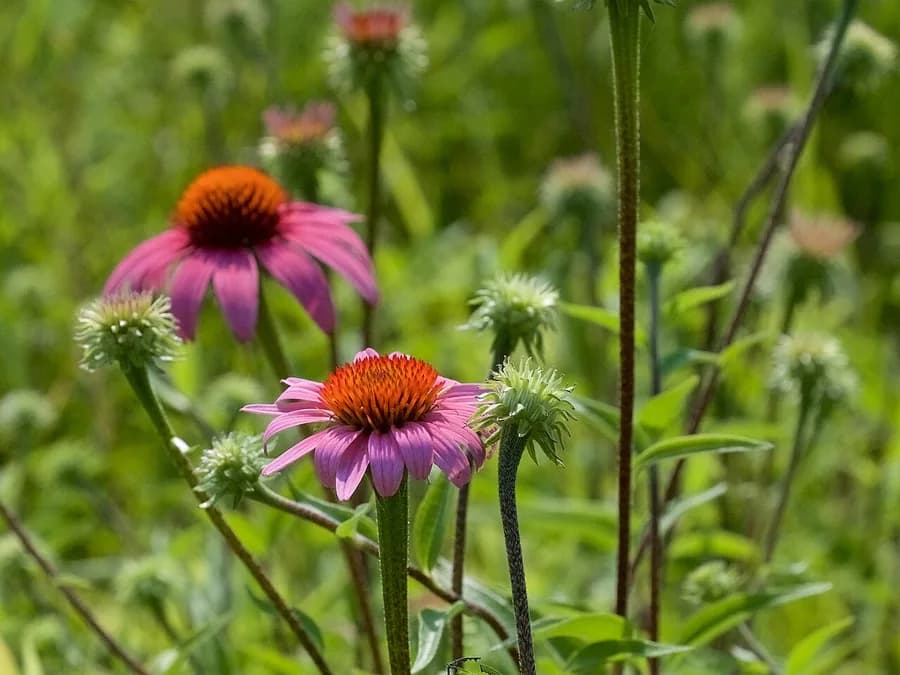
Echinacea purpurea is native to the prairies and woodland edges of central and eastern North America. Its seeds evolved to drop in autumn, sit through a cold wet winter, and germinate when spring warmth arrives. That cold period is not incidental — it is a chemical signal the seed uses to know that winter has actually passed and it is safe to sprout.
When you sow echinacea straight into warm soil in spring, you skip that signal entirely. Some seeds germinate anyway, because natural variation always hedges its bets. Many do not. The result is the patchy, disappointing tray that leads people to blame the seed supplier when the cause is a missing winter.
Cold, moist stratification, step by step
This is the single highest-value thing you can do for echinacea, and it requires a refrigerator and about four weeks of patience.
- Dampen a paper towel or a small handful of sand until it is barely moist — squeeze it and no water should run out. Too wet causes rot, which is the one way to make things worse.
- Fold the seeds into the towel, or mix them through the sand, and seal the lot in a labelled zip bag or small container.
- Put it in the main body of the refrigerator, not the freezer. You want roughly 1–5°C (34–40°F).
- Leave it for four weeks. Check once a week for mould, and discard any seed that has gone soft.
- Sow as normal at the end of the period. Some seeds may already have tiny root tips showing — handle those gently and plant them immediately.
When to plant echinacea seeds
Timing is the other half of the problem, and it works backwards from your last frost date. Because stratification takes four weeks and the seedlings need another six to eight weeks before they are ready to go outside, you need to start the process roughly ten to twelve weeks before you intend to transplant.
In practice that means putting seed in the refrigerator in mid to late winter — January or February for most of the United States — sowing indoors in early spring, and transplanting after the last frost has passed.
- Ten to twelve weeks before last frost: seed goes into the refrigerator to stratify.
- Six to eight weeks before last frost: sow the stratified seed indoors, 3–6 mm deep, at 18–21°C (65–70°F).
- After the last frost: harden seedlings off over a week and transplant, spacing 45–60 cm (18–24 in) apart.
- Alternative, no refrigerator needed: sow directly outdoors in late autumn and let the winter do the stratification for you. This is the least work and often gives the best results.
Sowing and early care
Sow at about 3–6 mm (1/8 to 1/4 inch) deep, lightly covered. Echinacea benefits from some light, so do not bury it deeply. Keep the medium consistently moist but never waterlogged, and aim for around 18–21°C (65–70°F) for germination.
Expect emergence anywhere from 10 to 30 days, and expect it to be uneven even after stratification. Seedlings are slow at first. This is normal for a perennial that is putting its early energy into roots rather than leaves.
The year-one expectation nobody sets
Echinacea is a true perennial, and in its first year it will usually build a root system and a modest clump of foliage without flowering at all. Gardeners who expect coneflowers in the first summer routinely conclude something has failed.
Nothing has failed. Year two is when it flowers, and from then on it is a long-lived, drought-tolerant, pollinator-heavy fixture that largely looks after itself. Leave the seed heads standing over winter and it will self-seed.
Traditional use, stated carefully
Echinacea has extensive documented use among Plains Indigenous peoples of North America, and it remains one of the most widely recognised plants in Western herbal tradition. That history is genuinely interesting and worth knowing.
It is also not the same thing as clinical evidence. This guide is about growing the plant successfully, and nothing here should be read as a claim that echinacea treats, prevents or cures anything.